Choosing a top pulmonologist is less about an unverified ranking and more about matching the doctor’s training, registration and current expertise to your symptoms and diagnostic problem. You will learn which warning signs need specialist or emergency care, what to bring to the first appointment, how tests are selected, and how to assess consultation and procedure safety.
Key takeaways
- Check specialist training against your lung condition and planned treatment.
- Seek emergency care for severe breathlessness, blue lips or sudden confusion.
- Bring symptom timing, medication lists, smoking history and prior scan reports.
- Ask what clinical question each test answers before agreeing to it.
How to Assess a Pulmonologist’s Expertise and Training
A top pulmonologist is not an objective ranking. Assess whether the doctor’s pulmonologist qualifications, specialist training and current practice match your condition, and whether complex cases receive coordinated review.
1. Verify an MBBS degree followed by MD or DNB in Respiratory Medicine, Pulmonary Medicine or Chest Medicine. Ask which institution awarded the postgraduate qualification.
2. Confirm medical registration in India through the state Medical Council or National Medical Commission register (NMC). Do not rely on a directory profile alone; check the registration number and current status.
3. Match subspecialist experience to your problem. Interventional bronchoscopy matters for airway lesions, thoracic oncology for suspected lung cancer, sleep medicine for sleep apnoea, pulmonary hypertension expertise for raised lung-artery pressure, and critical-care training for severe respiratory failure.
4. Ask how the doctor handles difficult cases. A lung-cancer service should coordinate bronchoscopy or biopsy with pathology, molecular testing and staging, while a complex surgical case should involve a thoracic surgeon.
Years in practice help only when paired with relevant case experience and current knowledge. Ask which investigations the pulmonologist interprets personally, how treatment decisions are reviewed, and whether continuing medical education keeps practice aligned with current guidelines.
Choose the clinician whose training and team fit your diagnosis, not the one carrying the strongest “top pulmonologist” label.
When Lung Symptoms Need Specialist or Emergency Assessment
Book a pulmonologist for a persistent cough lasting more than three weeks, unexplained breathlessness, recurrent pneumonia, abnormal chest imaging, low oxygen saturation, or ongoing lung disease symptoms despite initial treatment.
- Choose a general physician first for a new, mild cough, fever, wheezing, or short-lived breathlessness without red flags. They can examine you, check oxygen saturation, start basic investigations, and refer you when symptoms persist or the diagnosis is uncertain.
- Book a pulmonologist when spirometry is abnormal, symptoms keep returning, or a normal chest X-ray does not explain your breathlessness. Further assessment might require pulmonary-function testing, CT, bronchoscopy, or cardiac evaluation.
- Ask for prompt specialist assessment for coughing blood, unexplained weight loss, recurrent chest infections, or possible tuberculosis. A chest X-ray cannot confirm or exclude tuberculosis; rapid molecular testing and drug-resistance assessment are important when TB is suspected.
- Consult a thoracic surgeon when CT or bronchoscopy identifies a lung mass, airway lesion, pleural problem, persistent pneumothorax, or another condition that might need an operation or tissue removal. The pulmonologist and surgeon often decide this together.
- Go to emergency care for sudden breathlessness, severe chest pain, fainting, new confusion, blue lips, or coughing blood with breathing difficulty or weakness. Do not wait for a routine appointment; clinicians assess immediate threats such as pulmonary embolism before choosing tests such as D-dimer or CT pulmonary angiography.
What Happens at the First Pulmonology Consultation
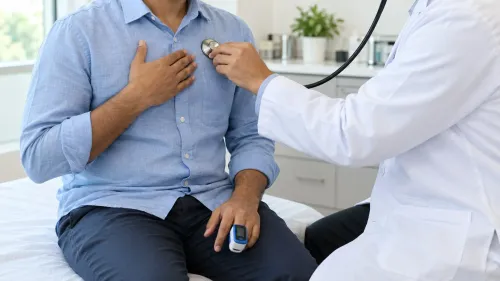
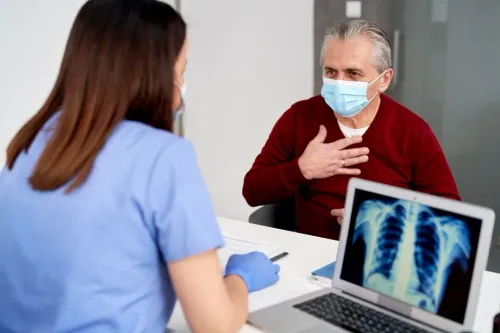
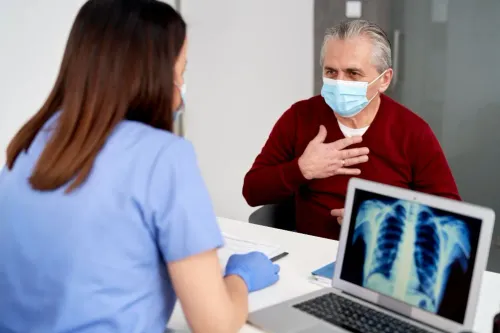
A first pulmonologist consultation starts with a clinical picture, not an automatic scan: your symptoms, timeline, oxygen level, exposures and examination determine whether further tests are needed and which question each test should answer.
1. Bring previous chest X-rays or CT reports, hospital records, blood-test results and a complete medication list. Explain when symptoms began, what triggers them, whether you have fever, weight loss, wheezing, chest pain or coughing blood, and how far you can walk before becoming breathless.
2. Expect a detailed smoking history and occupational exposure review. State how many cigarettes you smoked daily, for how many years, when you stopped, and whether you worked around asbestos, silica, coal dust, chemicals, mould or animal products.
3. The clinician will perform pulse oximetry, usually after you have rested, and may repeat the reading if your hands are cold, you are moving or the result conflicts with your appearance. Oxygen saturation is interpreted with your symptoms and medical history; breathlessness alone does not prove that you need long-term oxygen.
4. Chest examination includes listening for wheeze, crackles or reduced air entry, checking breathing effort, measuring respiratory rate and looking for blue lips, leg swelling or finger-clubbing. Only after this assessment will the pulmonologist choose observation, spirometry, imaging, blood tests or urgent care.
A lung nodule is not automatically cancer, and a smoker with symptoms needs diagnostic evaluation rather than screening alone.
How Pulmonologists Match Each Test to the Clinical Question
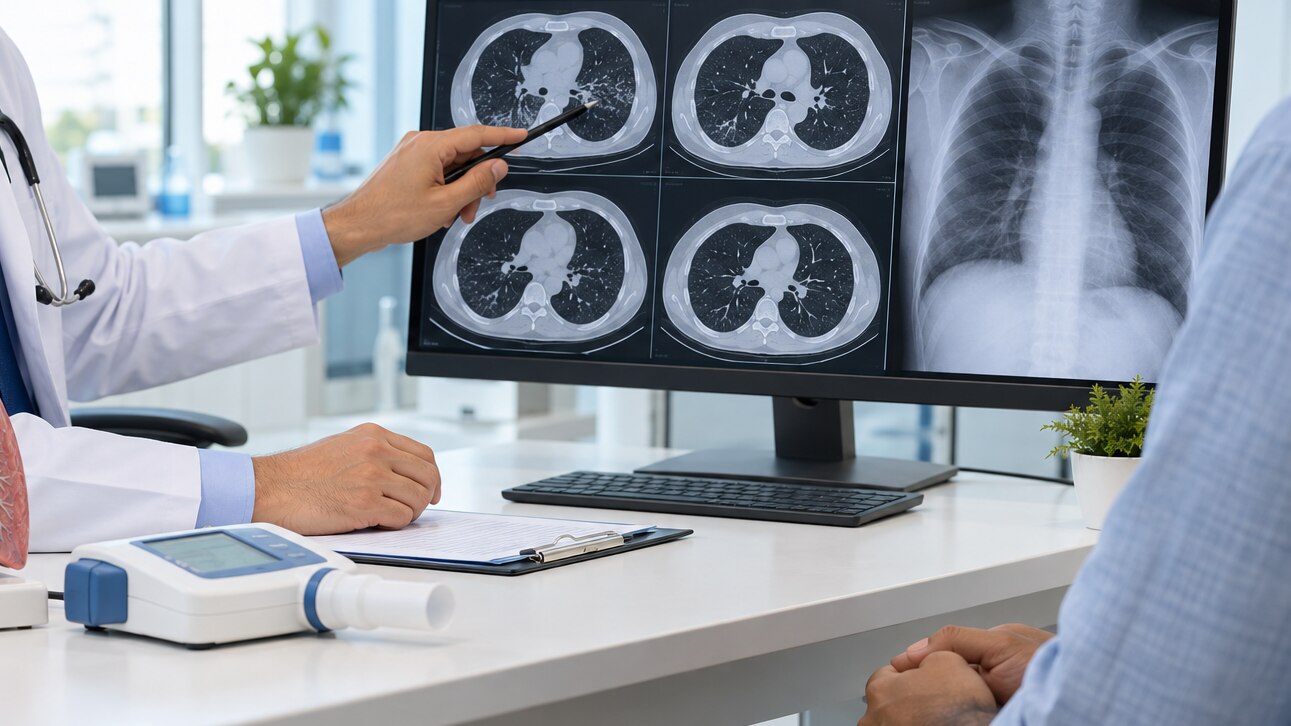
Doctors start with the clinical question, not a fixed test sequence. A chest X-ray versus CT choice depends on what must be seen: a normal X-ray does not exclude early cancer, pulmonary embolism, airway disease, or interstitial lung disease. Persistent breathlessness, haemoptysis, abnormal spirometry, or high-risk findings can justify escalation.
| Test | What it answers | When it applies |
|---|---|---|
| Chest X-ray | Shows major infection, fluid, collapse, or large masses | First-line imaging, but not reassurance when symptoms persist |
| High-resolution CT | Reveals fine lung detail, scarring, nodules, emphysema, and bronchiectasis | Suspected interstitial lung disease or unexplained abnormal imaging |
| CT pulmonary angiography | Shows clots blocking pulmonary arteries | Suspected pulmonary embolism after clinical probability assessment and, when appropriate, D-dimer; it is not automatic for every breathless patient |
| Pulmonary-function testing | Measures airflow, lung volumes, and gas transfer | Breathlessness, suspected obstruction or restriction, and treatment or surgical assessment |
| Bronchoscopy | Directly examines airways and collects washings or samples | Suspected airway blockage, bleeding, infection, or a reachable lesion |
| PET-CT | Maps metabolically active disease and possible spread | Staging a suspected or confirmed lung cancer |
| Tissue biopsy | Confirms diagnosis and supplies material for molecular testing | When imaging cannot distinguish cancer, infection, or another disease |
Spirometry requires coaching, a rapid start, adequate exhalation, repeatable blows, and a usable flow-volume curve. Doctors assess the FEV1 FVC ratio and bronchodilator test; cough, leaks, poor effort, or early stopping can require repetition.
For suspected cancer, the safest method that reaches the lesion determines whether sampling uses bronchoscopy, endobronchial ultrasound, CT-guided biopsy, or surgical biopsy. The choice must preserve enough tissue for molecular analysis.
Sleep Testing, Procedures and Safe Follow-Up After Diagnosis
A home sleep-apnoea test records breathing pauses, airflow and oxygen levels at home, but it does not assess every sleep disorder. Overnight polysomnography is the better choice when you have significant heart or lung disease, neuromuscular weakness, suspected hypoventilation, or another unexplained sleep problem.
Symptoms such as snoring and daytime sleepiness alone cannot confirm obstructive sleep apnoea.
The choice, flexible bronchoscopy versus rigid bronchoscopy, depends on the target and the planned treatment. Flexible bronchoscopy reaches smaller airways and supports washings, brushings, biopsies and endobronchial ultrasound-guided needle sampling. Rigid bronchoscopy provides a wider working channel for removing a larger airway obstruction, controlling bleeding or performing polypectomy under general anaesthesia.
A biopsy should use the safest route that answers the question: bronchoscopy, CT-guided needle biopsy or surgical biopsy. Discuss lung biopsy risks and aftercare before consent, including bleeding, infection, pneumothorax and whether the sample is sufficient for molecular tests and PD-L1 testing.
A lung nodule is not automatically cancer; size, growth, appearance and your treatment fitness can favour CT surveillance.
After bronchoscopy or polypectomy, follow the discharge instructions and avoid eating until swallowing sensation returns if sedation was used. Seek urgent care for worsening breathlessness, chest pain, heavy or persistent bleeding, fainting, fever or falling oxygen saturation.
Galaxy Chest & Multi Specialty Hospital Pvt Ltd can coordinate pulmonology, thoracic surgery, radiology, pathology and sleep-care reviews, preventing a biopsy result or procedure complication from being managed in isolation.
Frequently asked questions
How do you assess a pulmonologist’s expertise and training?
Check the doctor’s specialist qualifications, training in your condition, current clinical practice and access to coordinated review for complex cases.
When do lung symptoms require emergency assessment?
Seek emergency care for severe or rapidly worsening breathlessness, blue or grey lips, sudden confusion, chest pain with breathing difficulty or inability to speak in full sentences.
What happens during a first pulmonology consultation?
The pulmonologist reviews your symptoms, timing, medical history, medicines, smoking or exposure history, examination findings and previous reports before choosing next steps.
How do pulmonologists choose between lung tests?
They match each test to a clinical question, such as airflow, oxygen exchange, infection, structural change, sleep-related breathing or suspected cancer.
What happens after sleep testing or a lung procedure?
You receive results, a treatment plan and follow-up instructions, including warning signs, medication guidance and when repeat testing or review is needed.