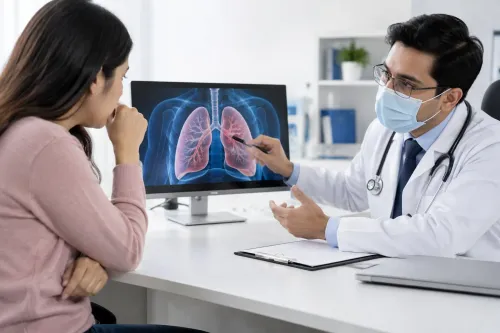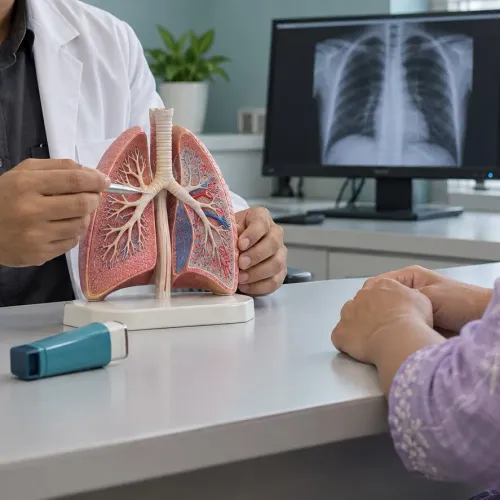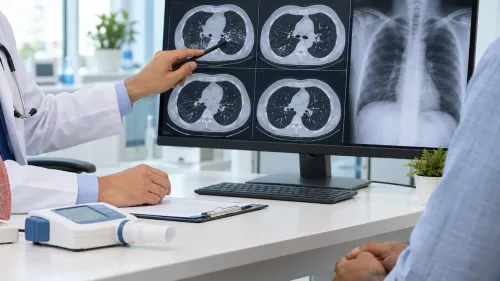

Choosing a chest specialist requires more than finding a doctor who treats cough or offers nebulisation. By comparing specialties, checking diagnostic capability, understanding emergency thresholds and preparing for the first consultation, you can judge which service fits your symptoms and risks.
Key takeaways
- Choose a pulmonologist when symptoms point to the lungs or airways.
- Seek emergency care for severe breathlessness, blue lips, confusion or low oxygen.
- Ask how spirometry, oxygen assessment and imaging support the diagnosis.
- Take inhalers, prescriptions, scans, test reports and a symptom timeline.
What a Chest Specialist Does Compared with Other Doctors
Choose the doctor by the immediate risk and the likely source: lungs, heart, infection or airway. A chest specialist, also called a pulmonologist or chest physician, evaluates asthma, COPD, pneumonia and wider lung disorders with objective respiratory testing, oxygen assessment and review of alternative diagnoses such as heart failure or pulmonary embolism.
| Doctor | Main purpose | When to choose |
|---|---|---|
| General physician | Coordinates common or early symptoms and referrals | First assessment of cough, breathlessness or fever |
| Pulmonologist or chest physician | Diagnoses and manages lung and airway disease | Abnormal spirometry, recurrent attacks, persistent symptoms or complex lung disease |
| Allergist | Identifies allergic triggers and immune conditions | Suspected allergic asthma, rhinitis or drug-related respiratory reactions |
| Infectious-disease doctor | Treats complex, resistant or prolonged infections | Tuberculosis, unusual pneumonia or treatment failure |
| Thoracic surgeon | Performs selected tissue sampling, drainage, airway intervention and lung or pleural surgery | A lesion, collection or airway problem requiring a procedure |
| Emergency physician | Stabilises immediate threats | Severe work of breathing, blue lips, confusion, shock or rapidly falling oxygen |
The general physician versus pulmonologist choice is often about coordination versus specialist testing. A strong chest service can perform quality respiratory tests, assess oxygenation, recognise non-lung causes and escalate to emergency care, intensive care or thoracic surgery.
Pulmonology and thoracic surgery are complementary, not interchangeable. Suspected lung cancer needs tissue diagnosis or a sound diagnostic plan, staging and cardiopulmonary fitness assessment through multidisciplinary decision-making before treatment.
How to Choose a Specialist for Asthma or COPD
Do not accept an asthma or COPD label based only on wheeze, cough, breathlessness or a normal chest X-ray. An asthma specialist should seek objective evidence and explain what happens when the results do not fit.
| Condition | Evidence to confirm | Review before escalation |
|---|---|---|
| Asthma | Spirometry with bronchodilator testing showing variable expiratory airflow limitation; in adults, FEV1 or FVC rises at least 12% and 200 mL | Inhaler technique review, adherence, triggers, allergy, rhinitis, reflux, obesity and other comorbidities |
| COPD | Post-bronchodilator FEV1/FVC below 0.70 | Smoking and biomass-fuel exposure, oxygenation, inhaler choice, vaccinations and alternative diagnoses |
If initial spirometry is normal but asthma remains possible, ask which objective test comes next, such as serial peak-flow variability or bronchial challenge testing. A single wheeze episode does not prove asthma.
A suitable specialist should provide a written asthma action plan, including daily treatment, worsening symptoms, reliever instructions and emergency thresholds. Frequent attacks or frequent short-acting reliever use require reassessment, not simply a stronger nebuliser.
For COPD, smoking, biomass exposure, cough and breathlessness justify testing but do not establish the diagnosis. Ask about exacerbation planning, smoking cessation, exposure reduction, vaccination, oxygen assessment and evaluation for heart failure or bronchiectasis.
Pulmonary rehabilitation combines supervised exercise training, education and behaviour change. Repeated nebulisers alone do not demonstrate chronic-care capability; ask whether the service offers rehabilitation and structured follow-up.
How Pneumonia Severity and Emergency Risk Are Judged
Routine review suits a stable person who can drink, think clearly, breathe comfortably and maintain oxygen saturation without increasing support. Hospital treatment becomes more likely with low oxygen saturation, fast respiratory rate, low blood pressure, rapid pulse, dehydration, significant comorbidity, abnormal mental status or an unsafe home setting.
A proper pneumonia assessment combines vital signs, mental status, chest examination and a chest X-ray when indicated. The Pneumonia Severity Index is preferred over CURB-65 by the ATS/IDSA guideline for admission decisions, but clinical judgment remains essential; a cough or infiltrate does not determine severity by itself.
- Ask whether severe community-acquired pneumonia criteria are present. Major criteria are invasive mechanical ventilation or septic shock requiring vasopressors. Three or more minor criteria support ICU-level consideration: respiratory rate at least 30/min, PaO2/FiO2 at or below 250, multilobar infiltrates, confusion, blood urea nitrogen at least 20 mg/dL, white-cell count below 4,000/µL, platelets below 100,000/µL, temperature below 36°C, or hypotension needing aggressive fluids.
- Ask whether the patient has reached clinical stability before stopping antibiotics. Hospitalised adults usually receive at least five days; complications, unusual organisms or poor response require longer treatment.
- Know when to go to emergency care: severe work of breathing, inability to speak full sentences, blue lips, confusion or drowsiness, rapidly falling or very low oxygen saturation, shock, chest pain, or large or persistent haemoptysis.
- In acute COPD exacerbation, target oxygen saturation is usually 88–92% while blood gases are assessed. Persistent hypercapnic respiratory acidosis, often pH 7.35 or lower after initial treatment, may require monitored NIV; an obtunded or deteriorating patient needs airway protection.
Tests That Separate Asthma, COPD and Other Lung Disorders
Variable symptoms with reversible airflow limitation point toward asthma; persistent post-bronchodilator obstruction with smoking or biomass exposure supports COPD. No symptom pattern replaces objective testing.
| Pattern | Clues that raise suspicion |
|---|---|
| Asthma | Variable wheeze, cough or breathlessness; spirometry showing reversibility, such as FEV1 or FVC rising at least 12% and 200 mL after bronchodilator |
| COPD | Persistent post-bronchodilator FEV1/FVC below 0.70 plus smoking or biomass exposure |
| Pneumonia | Fever, acute cough and an infiltrate on chest X-ray |
| Bronchiectasis or tuberculosis | Daily sputum and recurrent infections; chronic cough with weight loss, night sweats or exposure risk requires sputum testing for tuberculosis |
| Other serious disease | Crackles or restrictive physiology suggests interstitial lung disease; sudden breathlessness, pleuritic pain or unexplained low oxygen raises pulmonary embolism; blood-streaked sputum, weight loss, a mass or non-resolving opacity requires a lung-cancer work-up |
The practical work-up uses quality-controlled spirometry, bronchodilator testing, peak-flow measurement, lung volumes and diffusing capacity. Reference equations and test quality affect interpretation; one peak-flow reading is not a full pulmonary function assessment. Add chest X-ray, CT chest, allergy testing, arterial blood gas analysis, sputum testing or a sleep study when sleep-related breathing disease is suspected.
Bronchoscopy is chosen for direct airway inspection or targeted sampling, not automatically for every cough or nodule. CT-guided biopsy or CT surveillance can be safer alternatives, depending on lesion location, bleeding risk and oxygenation.
What to Take to the First Consultation and How to Compare Services
Bring organised medical records to bring to your first pulmonology consultation: prior chest X-rays and CT scans with reports, spirometry or blood-gas results, discharge summaries, prescription lists, inhalers and nebuliser medicines, allergy details, and vaccination records.
Write a timeline covering attacks, fever, smoking or biomass exposure, and oxygen readings. Include dates, triggers, treatments taken, hospital visits and how quickly symptoms improved.
Use these questions to ask a chest specialist:
- What is the working diagnosis, and which finding confirms it?
- What alternatives are being ruled out?
- What is the treatment goal, and how will I know it is working?
- When should I return, and when should I seek emergency help?
Compare services by capability, not by a nebuliser alone.
| Capability | What to verify | Why it matters |
|---|---|---|
| Pulmonary testing | Quality-assured spirometry, bronchodilator testing, lung volumes and diffusing capacity | Separates obstruction, restriction, poor effort and gas-transfer problems |
| Assessment | Oxygen measurement, arterial blood gases, sputum testing and allergy testing | Identifies severity, infection, allergy and respiratory failure |
| Long-term care | Pulmonary rehabilitation, inhaler review and exposure reduction | Supports stable COPD and asthma control |
| Escalation | Monitored NIV and prompt emergency, intensive-care or thoracic-surgery referral | Prevents delays during deterioration |
Judge Galaxy Chest & Multi Specialty Hospital Pvt Ltd in Trichy by these measurable capabilities and its escalation pathway, not equipment displayed in reception.
Choose a specialist who can provide:
- Stable follow-up with objective testing and a written plan
- Pulmonary rehabilitation and prevention support
- Rapid escalation for worsening oxygen, severe breathing effort, confusion or persistent bleeding
Frequently asked questions
What does a chest specialist do compared with other doctors?
A chest specialist, or pulmonologist, evaluates lung and airway conditions using respiratory tests, oxygen assessment and imaging while checking for alternatives such as heart failure or pulmonary embolism.
How do I choose a specialist for asthma or COPD?
Check the doctor’s experience with asthma or COPD, access to spirometry and oxygen testing, ability to review imaging, and a clear plan for follow-up and inhaler treatment.
How is pneumonia severity and emergency risk judged?
Clinicians assess breathing difficulty, oxygen level, mental alertness, blood pressure, fever, age, existing conditions and chest imaging to decide whether home care, admission or emergency treatment is needed.
Which tests separate asthma, COPD and other lung disorders?
Spirometry with bronchodilator testing helps identify airflow limitation; oxygen measurement, chest X-ray or CT, blood tests and additional tests help investigate infection, heart disease and other lung disorders.
What should I take to my first chest specialist consultation?
Bring your inhalers, medicine list, prior prescriptions, scan and X-ray reports, lung-function results, oxygen readings, allergy history and a timeline of symptoms.