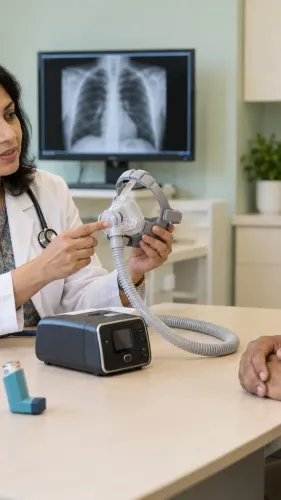

The right pulmonary specialist is not chosen by title alone. You need to match the clinician’s experience, diagnostic reach, emergency support and follow-up system to the difference between a long-term condition such as asthma or COPD and a high-risk problem such as lung cancer, airway obstruction or respiratory failure.
Key takeaways
- Choose an adult pulmonologist experienced in long-term disease monitoring.
- Match each lung test to the question it is designed to answer.
- Compare hospital respiratory services, emergency support and follow-up access.
- Bring medication lists, scan reports, symptom timing and previous test results.
What qualifications matter for chronic versus complex respiratory disease?
For chronic respiratory conditions, choose a pulmonary specialist trained in adult pulmonology who can monitor disease, interpret changing results and adjust treatment over time. This matters for asthma, COPD, bronchiectasis, interstitial lung disease and obstructive sleep apnoea, where one consultation rarely settles the diagnosis or treatment.
Look for documented experience in the condition involved, access to spirometry and full pulmonary-function testing, and bronchoscopy when tissue or airway samples are needed. An asthma specialist may suit difficult allergic asthma, while suspected interstitial lung disease deserves multidisciplinary review of high-resolution CT, exposure history and pulmonary-function trends.
Complex respiratory conditions need broader capability. Ask whether the service manages airway obstruction, lung cancer, recurrent pleural disease, respiratory failure and pulmonary hypertension, and has links to thoracic surgery, oncology, sleep medicine and intensive respiratory care. An abnormal echocardiogram suggests pulmonary hypertension; right-heart catheterisation confirms it.
| Clinician | Best fit | Escalate or refer when |
|---|---|---|
| General physician | Initial uncomplicated cough, fever or wheeze | Symptoms persist, recur or need specialist testing |
| Emergency department | Severe breathlessness, confusion, cyanosis, inability to speak in full sentences or rapidly falling oxygen | Ventilatory support or urgent stabilisation is needed |
| Sleep physician | Isolated snoring, witnessed apnoeas, morning headaches or daytime sleepiness | Lung disease or broader breathing problems also appear |
| Allergist | Selected allergic disease or difficult triggers | Asthma remains uncontrolled or diagnosis is uncertain |
| Infectious-disease specialist | Difficult or confirmed infections | Structural lung disease or respiratory failure complicates infection |
| Thoracic surgeon | An operation is being considered | A pulmonary specialist must coordinate testing and non-surgical care |
A pulmonary specialist is most valuable when the diagnosis crosses these boundaries.
Which tests should a pulmonary specialist use, and what does each one show?
History and examination come first. Ask about smoking, workplace dust or chemicals, medication use, infection and tuberculosis risk, symptom timing, wheeze, sputum, fever, weight loss and exercise limitation. This pattern determines which test answers the next question.
| Test | What it shows | When it helps |
|---|---|---|
| Pulse oximetry | A quick estimate of blood oxygen saturation | Breathlessness, cyanosis or suspected respiratory failure |
| Spirometry with bronchodilator testing | Airflow obstruction and reversibility | Asthma or COPD assessment; COPD requires post-bronchodilator FEV1/FVC below 0.70, interpreted with clinical context |
| Full pulmonary-function testing | Lung volumes and diffusion capacity, in addition to airflow | Unexplained breathlessness, restriction or suspected interstitial disease |
| Chest X-ray | A first-line view of lungs, heart and pleura | Initial structural assessment |
| High-resolution CT | Fine detail of fibrosis, bronchiectasis, pleural disease and nodules | Abnormal X-ray or suspected interstitial lung disease |
| Bronchoscopy and EBUS biopsy | Lavage, brushings, airway or lung biopsies, and lymph-node samples | Infection, bleeding, airway lesions or suspected lung cancer |
| Sleep study testing | Breathing interruptions and oxygen changes during sleep | Suspected obstructive sleep apnoea |
| Blood and sputum tests | Infection, tuberculosis, eosinophilic inflammation or autoimmune clues | Persistent, recurrent or unexplained disease |
Normal spirometry does not exclude asthma. Repeat testing during symptoms, peak-flow variability or a bronchial challenge may be needed. Echocardiography estimates pulmonary-hypertension probability; right-heart catheterisation confirms it through direct pressure measurements. Suspected idiopathic pulmonary fibrosis needs multidisciplinary review of exposure history, autoimmune tests, CT patterns, lung-function trends and biopsy results.
How should you compare a pulmonary specialist and hospital before booking?
Choose the hospital that can show how it evaluates your case, not the one that simply calls itself the best pulmonary specialist. Ask how long the first consultation lasts, whether the doctor personally reviews CT images rather than only reports, and whether pulmonary-function results are interpreted alongside symptoms, exposures and examination findings.
| Comparison point | Stronger option | Warning sign |
|---|---|---|
| Consultation | Gives time for history, examination and questions | Rapid review with no records checked |
| Complex diagnosis | Uses multidisciplinary respiratory care with radiology, pathology, oncology, thoracic surgery and intensive-care teams | One clinician makes every decision alone |
| Procedures | Provides bronchoscopy capability, biopsy planning, pathology review and anaesthesia coverage | Procedure offered without a clear tissue or safety plan |
| Critical illness | Has ICU and ventilator support, thoracic-surgery backup and an emergency transfer arrangement | No stated escalation route for respiratory failure |
| Infection control | Explains room cleaning, equipment sterilisation and respiratory isolation | Vague answers about shared equipment or isolation |
Ask who answers worsening symptoms outside clinic hours and how quickly you can reach emergency assessment. Increasing work of breathing, confusion, blue lips, inability to speak full sentences or rapidly falling oxygen saturation needs urgent care, not a routine appointment.
For sleep-related symptoms, ask whether the clinician screens for witnessed apnoeas, morning headaches, resistant hypertension and daytime impairment, then arranges polysomnography or a validated home sleep-apnoea test when appropriate.
In Trichy, compare Galaxy Chest & Multi Specialty Hospital Pvt Ltd with another hospital by requesting these details, the clinician’s relevant experience and the escalation process, rather than accepting unsupported outcome claims.
What should you bring to the first consultation?
Bring these records to your first pulmonary consultation; missing information can force repeat tests and obscure the diagnosis.
- Complete medication list with doses, recent antibiotics and steroids, inhaler names, spacers, and the inhalers themselves for an inhaler technique review.
- Symptom log covering timing, night waking, exercise limits, wheezing, sputum colour, fever, weight loss, coughing blood, and witnessed breathing pauses.
- Smoking and occupational exposure history, including pack-years and contact with dust, silica, asbestos, biomass fuel, mould, birds, or workplace chemicals. Persistent cough, fever, night sweats, weight loss, or coughing blood also warrants discussion of tuberculosis testing; a normal X-ray does not exclude it.
- Oxygen and ventilator settings: prescribed flow rate, hours of use, device settings, and recent downloads.
Bring original imaging files, not only printed reports.
| Item | What to bring | Why it matters |
|---|---|---|
| Imaging | Chest X-rays and CT scans on disc or through the imaging portal | Allows image review and avoids unnecessary repeat scans |
| Tests | Pulmonary-function reports, blood results and sputum results | Shows trends and missing investigations |
| Hospital records | Discharge summaries, biopsy reports and pathology records | Connects previous diagnoses and treatments |
Ask whether any medicine must be paused before testing. Do not stop inhalers or oxygen without specific instructions from the clinician.
How can you tell whether the diagnosis and treatment plan are adequate?
An adequate plan names the working diagnosis, shows the evidence supporting it and sets measurable treatment goals: fewer exacerbations, longer walking distance, better spirometry, controlled night symptoms or safe oxygen levels. It also records what would prove the diagnosis wrong.
Your review should cover inhaler technique, exposure reduction, vaccination advice, smoking cessation and pulmonary rehabilitation. Pulmonary rehabilitation combines tailored exercise, education and behaviour change; generic exercise advice is not an equivalent substitute.
Ask when each investigation will be repeated and what result would change treatment:
| Test | Follow-up question |
|---|---|
| Spirometry | When will airflow be reassessed, and what result changes inhalers? |
| Full pulmonary-function tests | When will lung volumes and diffusion capacity be checked? |
| CT imaging | What growth or pattern would alter surveillance or treatment? |
| Oxygen assessment | What saturation or exertional result changes oxygen support? |
| Sleep testing | What finding changes treatment for suspected sleep apnoea? |
For lung nodule follow-up, ask how size, solid or subsolid appearance, growth, multiplicity and cancer risk determine surveillance. A nodule does not automatically require surgery. For lung cancer, discuss stage, cardiopulmonary reserve, predicted postoperative lung function and alternatives such as stereotactic radiation, systemic therapy or combined treatment.
Do not wait for clinic review if respiratory failure warning signs appear: rising work of breathing, confusion, blue lips or skin, inability to speak in full sentences, significant haemoptysis or rapidly falling oxygen saturation. Seek emergency care.
Frequently asked questions
What qualifications matter for chronic versus complex respiratory disease?
Look for an adult pulmonologist with experience managing the specific condition, interpreting serial test results and adjusting treatment over time. Complex cases also require access to respiratory investigations, multidisciplinary review and thoracic or critical-care support when needed.
Which tests should a pulmonary specialist use, and what does each one show?
Spirometry measures airflow obstruction; bronchodilator testing checks reversibility; full pulmonary function testing measures lung volumes and gas transfer; chest X-ray and CT show structural changes; pulse oximetry and arterial blood gas assess oxygen and carbon dioxide; sleep studies identify sleep-related breathing disorders. The specialist should explain why each test is needed.
How should you compare a pulmonary specialist and hospital before booking?
Check the specialist’s experience with your condition, the hospital’s available lung tests, access to bronchoscopy and thoracic surgery when indicated, emergency respiratory support, report turnaround and follow-up arrangements.
What should you bring to the first consultation?
Bring a current medication list with doses, inhalers, allergy details, smoking history, symptom timeline, previous prescriptions, spirometry results, X-rays or CT scans, discharge summaries and a record of flare-ups or hospital visits.
How can you tell whether the diagnosis and treatment plan are adequate?
You should receive a working diagnosis, the evidence supporting it, tests still required, clear medication instructions, inhaler-technique guidance, warning signs, follow-up timing and measurable goals such as fewer flare-ups or improved lung function.