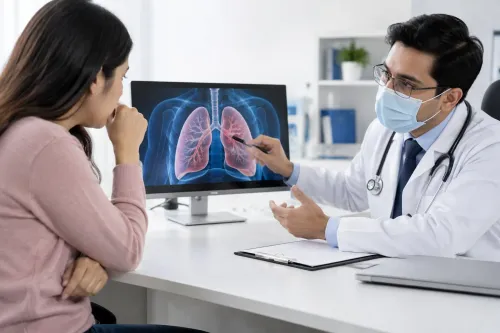

Breathlessness, persistent cough, wheezing and repeated chest infections can come from the lungs, heart, airways, sleep-related breathing problems or a serious underlying disease. By the end, you will know when a pulmonary doctor is the right clinician, which warning signs need urgent care, how to prepare for the appointment and how common lung tests guide treatment.
Key takeaways
- Seek care for persistent cough, breathlessness, wheezing or repeated chest infections.
- Bring medication lists, previous scans, test reports and symptom details to your first visit.
- Spirometry compares exhaled air volume and flow to identify obstructive or restrictive patterns.
- Advanced investigation is important for unexplained symptoms, abnormal scans or suspected lung cancer.
When Should You See a Pulmonary Doctor?
See a pulmonary doctor for persistent or unexplained breathing problems, especially asthma, COPD symptoms and diagnosis support, chronic cough, breathlessness, wheezing, recurrent chest infections, pneumonia or tuberculosis. Pulmonary expertise also matters for interstitial lung disease, pulmonary fibrosis, pulmonary hypertension and suspected lung cancer.
Seek emergency care for severe breathlessness at rest, blue lips, significant coughing of blood, sudden chest pain, confusion, low oxygen saturation or rapidly worsening symptoms. Chest pain or breathlessness alone cannot confirm or exclude pulmonary embolism; clinicians assess clinical probability, use D-dimer only in selected patients, and order CT pulmonary angiography when indicated.
Pulmonary care differs by the suspected organ system:
| Clinician | Symptom pattern or concern | Usual role |
|---|---|---|
| General physician | New, mild or straightforward symptoms | Initial assessment and treatment; referral when symptoms persist, recur or remain unexplained |
| Allergist | Seasonal symptoms, itching, sneezing or allergy-linked wheeze | Allergy testing and trigger management; refer for persistent lower-airway disease |
| ENT specialist | Nasal blockage, sinus disease, hoarseness or throat-origin cough | Nose, sinus, throat and upper-airway assessment |
| Cardiologist | Fainting, leg swelling, palpitations or exertional breathlessness suggesting heart disease | Cardiac testing; pulmonary review when lung disease or pulmonary hypertension is possible |
| Pulmonary doctor | Lower-airway, lung tissue, pleural or respiratory symptoms | Specialist testing and care for asthma, COPD, infections, fibrosis and suspected cancer |
How to Prepare for Your First Pulmonary Consultation
Bring records that show what has already been investigated before your pulmonary consultation. Knowing what to bring to a lung doctor prevents repeat testing and helps connect older findings with current symptoms.
1. Collect previous chest X-rays, CT scans, spirometry or pulmonary function reports, discharge summaries, and blood or sputum results. Bring the actual images on a disc or online link when available, not only the written report.
2. Write a complete medication list with every inhaler’s name, dose, and frequency. Add tablets, nebulised medicines, allergy history, smoking history, and any occupational lung exposure involving dust, silica, asbestos, or chemical fumes.
3. Prepare a symptom timeline: record when symptoms began, what triggers them, whether they wake you at night, and how breathlessness, cough, wheezing, or sputum has changed.
4. Expect detailed history-taking, oxygen saturation measurement, and a chest examination. The doctor will review your imaging and reports, check inhaler technique, and decide whether you need spirometry, full pulmonary function testing, blood work, sputum testing, imaging, or another investigation.
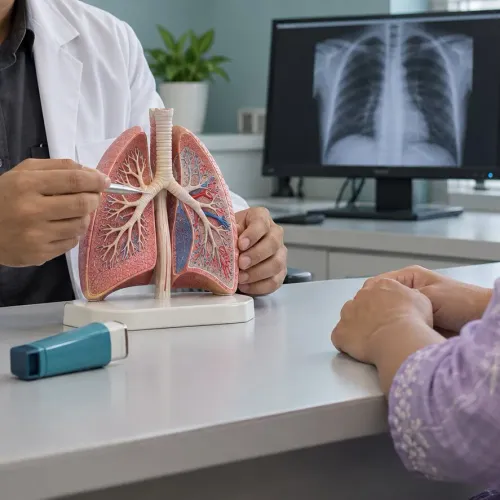
5. Demonstrate how you use every inhaler. Naming the device is not enough: poor inhaler technique or missed doses can imitate treatment failure, leading to unnecessary medicine changes. The doctor can correct your steps and recommend a spacer with an appropriate pressurised metered-dose inhaler. Ask what each test is intended to answer before leaving.
Which Lung Tests Are Chosen, and How Should You Read Spirometry?
A pulmonary doctor matches each test to the question: airflow, lung size, gas transfer, structure, infection, sleep-related obstruction or heart function.
| Test | Main question | When it applies |
|---|---|---|
| Spirometry | Is airflow limited? | Cough, wheeze, breathlessness, suspected asthma or COPD |
| Full pulmonary function testing | What are lung volumes and gas transfer? | Suspected restriction, fibrosis or unexplained breathlessness |
| Chest X-ray | Is there an initial structural abnormality? | First-line imaging for many chest symptoms |
| High-resolution CT | Is there interstitial disease, fibrosis or a detailed lung abnormality? | Abnormal X-ray or suspected diffuse lung disease |
| Bronchoscopy | Is there an airway, infection, bleeding or tissue problem? | Selected cases requiring direct inspection or sampling |
| Sleep testing | Is obstructive sleep apnea present? | Snoring, witnessed pauses and daytime sleepiness |
| Blood or sputum testing | Is inflammation or infection present? | Fever, productive cough or suspected tuberculosis |
| Cardiac evaluation | Is the heart causing symptoms or pulmonary hypertension? | Breathlessness with cardiac signs or risk factors |
Spirometry results report FEV1, the air exhaled in the first second; FVC, the total forced exhaled volume; and the FEV1/FVC ratio. Obstruction lowers the ratio, while restriction often lowers FVC with a normal or high ratio, requiring full testing to confirm.
Under GOLD, COPD requires a post-bronchodilator FEV1/FVC below 0.70; ATS/ERS interpretation also considers the age-adjusted lower limit of normal.
Avoid smoking, heavy meals and vigorous exercise before testing as instructed. Seal your lips, inhale fully, then blow hard and continue until empty; repeat acceptable blows. Poor effort or technique creates misleading values. A bronchodilator response supports variable airflow, but asthma can have normal spirometry between episodes.
How Does a Pulmonary Doctor Choose Safe, Effective Treatment?
COPD treatment starts with checking whether the plan works in real life, not simply adding another inhaler. A pulmonary doctor watches you use each device, corrects technique, reviews missed doses and cost or scheduling barriers, and adds a spacer when appropriate for a pressurized metered-dose inhaler.
Pulmonary rehabilitation combines exercise training, education and behavior change to improve function and daily control.
Antibiotics are not routine for every COPD exacerbation. Increased breathlessness, increased sputum volume and especially purulent sputum support their use, alongside illness severity, ventilatory-support needs and local resistance patterns.
For hospitalized COPD patients with acute or acute-on-chronic respiratory acidosis, non-invasive ventilation is used when pH is typically 7.35 or lower, provided no contraindication or deterioration requires invasive ventilation.
Oxygen decisions depend on the situation:
| Situation | Treatment target or rule | Why it matters |
|---|---|---|
| Emergency, hypercapnia risk | Oxygen saturation target 88–92% until blood gases are available | Uncontrolled high-flow oxygen can worsen carbon-dioxide retention |
| Stable severe resting hypoxemia | Long-term oxygen after confirmation while clinically stable; PaO2 ≤55 mmHg or saturation ≤88% | This is different from treating moderate desaturation |
| Moderate exertional desaturation | Do not prescribe routine long-term oxygen solely for this finding | Confirm benefit and reassess after an exacerbation |
Reassess oxygen need after recovery because an exacerbation can temporarily lower oxygen levels. A safe plan matches treatment intensity to measured physiology, symptoms and response.
When Does Lung Care Require Advanced Investigation or Thoracic Treatment?
A new, unexplained or clinically significant pleural effusion often needs diagnostic thoracentesis. Light’s criteria identify an exudate when any one threshold is met: pleural-fluid/serum protein above 0.5, pleural-fluid/serum LDH above 0.6, or pleural-fluid LDH above two-thirds of the laboratory’s upper limit of normal serum LDH.
Lung cancer diagnosis and staging require tissue diagnosis, imaging-based staging and, when relevant, molecular and biomarker testing. A report that says only “lung cancer” may not identify a subtype or provide the information needed for targeted therapy or immunotherapy.
Annual low-dose CT screening applies only to people meeting the relevant guideline. Under USPSTF criteria, that means age 50–80, at least 20 pack-years, and current smoking or quitting within 15 years; it is not routine scanning for every nonsmoker.
| Finding | Preferred investigation | When it applies |
|---|---|---|
| Pleural effusion | Thoracentesis and fluid analysis | New, unexplained or clinically significant fluid |
| High-risk sleep-apnoea symptoms | Portable sleep-apnoea test | Selected adults without major complicating conditions |
| Complex sleep presentation | Polysomnography | Cardiopulmonary disease, neuromuscular weakness, opioid use, stroke, severe insomnia or suspected non-obstructive disease |
Minimally invasive thoracic surgery is chosen according to anatomy, tumour stage, disease extent, surgical expertise and the need for complete resection. Galaxy Chest & Multi Specialty Hospital Pvt Ltd can coordinate pulmonary assessment, investigations, respiratory treatment and thoracic surgical review when thoracic surgery in Trichy forms part of one clinical pathway.
Frequently asked questions
When should you see a pulmonary doctor?
See one for persistent or unexplained cough, breathlessness, wheezing, recurrent chest infections, pneumonia, tuberculosis, asthma, COPD symptoms or abnormal chest imaging. Specialist care also helps with interstitial lung disease, pulmonary fibrosis, pulmonary hypertension and suspected lung cancer.
How should you prepare for your first pulmonary consultation?
Bring your medication list, previous prescriptions, chest X-rays or CT scans, pulmonary function reports, discharge summaries and details about smoking, workplace exposures and symptom triggers. Record when symptoms began, what worsens them and how they affect walking, sleep or daily activities.
Which tests might a pulmonary doctor choose?
The choice depends on your symptoms and examination. Tests can include spirometry, full pulmonary function testing, oxygen measurement, chest X-ray, CT scan, blood tests, sputum testing, bronchoscopy or an echocardiogram when pulmonary hypertension is suspected.
How do you read spirometry results?
Focus on FEV1, FVC and the FEV1/FVC ratio, then compare them with the predicted values and lower limit of normal on the report. A low ratio supports airflow obstruction; low FVC requires further testing before confirming restriction. A clinician must interpret results alongside symptoms and test quality.
When does lung care require advanced investigation or thoracic treatment?
Escalation is appropriate when symptoms remain unexplained, scans show a mass or persistent abnormality, oxygen levels fall, disease progresses despite treatment or a condition affects the airway, pleura or chest wall. Investigation can include CT, bronchoscopy, biopsy or specialist thoracic treatment.