
A cough lasting more than eight weeks, breathlessness that limits ordinary activity, or repeated chest infections needs more than another course of antibiotics. You will learn which symptoms require emergency care, what a lung specialist investigates, how tests are selected, and how to prepare for a useful appointment.
Key takeaways
- Seek emergency care for severe breathlessness, blue lips, confusion, or chest pain.
- Arrange assessment for a cough lasting more than eight weeks.
- Recurring infections in the same lung area need investigation.
- Expect lung function tests, imaging, and a detailed symptom history.
Decide whether your symptoms need emergency care or specialist review
A cough lasting more than eight weeks in an adult is chronic cough and deserves a planned medical assessment, even if you feel well. Breathlessness that is new, worsening or limiting ordinary walking needs faster review. Recurring chest infections need investigation when they return, produce daily sputum or affect the same lung area.
| Situation | What to do | Why it matters |
|---|---|---|
| Severe breathlessness at rest, blue lips, confusion, oxygen saturation of 90% or lower, or rapidly worsening symptoms | Seek emergency assessment now | These urgent respiratory symptoms can indicate dangerously low oxygen, severe infection, pulmonary embolism or another life-threatening problem |
| Coughing up more than a small streak of blood, severe chest pain, fainting or inability to speak in full sentences | Seek emergency assessment now | Delay can be dangerous |
| A small blood streak, unexplained weight loss, persistent fever, hoarseness or repeated pneumonia in the same region | Arrange prompt medical review | These findings need assessment for obstruction, tuberculosis, cancer or complicated infection |
| Stable chronic cough, exertional breathlessness or recurring chest infections without warning signs | Book a lung-specialist appointment | Asthma, COPD, bronchiectasis, reflux, post-nasal drip, medication effects and heart disease require structured evaluation |
Do not repeatedly self-treat with leftover antibiotics or cough medicines. A chest X-ray helps assess many causes but can miss early cancer, pulmonary embolism and small-airway disease, so persistent unexplained symptoms may require CT, spirometry or other targeted tests. Bring oxygen readings, fever records, sputum details, smoking history and previous scan reports.
What a chronic cough can reveal about its cause
A cough lasting more than 8 weeks is chronic, and its pattern often narrows the cause before testing begins. Night-time or exercise-related cough with wheeze suggests asthma, while daily phlegm, exertional breathlessness and smoking or dust exposure raise concern for COPD. A normal chest X-ray does not exclude asthma or airway inflammation.
| Cause | Clues in the history | Details a specialist checks |
|---|---|---|
| Asthma | Variable cough, wheeze, chest tightness; worse with exercise, cold air or allergens | Spirometry, bronchodilator response, peak-flow variation or airway inflammation |
| COPD | Persistent phlegm and breathlessness; smoking, biomass fuel or workplace dust exposure | Post-bronchodilator FEV1/FVC below 0.70, interpreted with age and symptoms |
| Post-nasal drip | Throat clearing, nasal blockage, a sensation of mucus dripping behind the throat | Rhinitis or sinus examination; response to targeted post-nasal drip cough treatment |
| Reflux | Cough after meals or lying down, sour taste, hoarseness; heartburn can be absent | Meal timing, reflux triggers and response to treatment |
| Infection | Fever, sudden worsening, purulent sputum or contact with tuberculosis | Examination, chest imaging and sputum testing when indicated |
Review every medicine, especially an ACE inhibitor such as ramipril, and record when the cough began. More than one cause can coexist, so treating asthma or reflux alone may fail.
Coughing blood, weight loss, persistent fever, hoarseness, repeated pneumonia in one area or a smoking history needs prompt assessment for cancer, tuberculosis or structural lung disease.
When repeated chest infections point to a different problem
Recurrent pneumonia means repeated episodes with compatible symptoms and a new lung shadow on imaging; wheezing, cough and breathlessness without a new infiltrate point more towards an asthma or COPD flare-up. A chest infection that returns after treatment is not proof of another pneumonia.
Clues that justify a deeper investigation include:
- Daily sputum, especially large volumes of yellow or green sputum, suggests bronchiectasis rather than isolated pneumonia.
- Episodes in the same lobe raise concern about a blocked airway, foreign body, tumour or local structural problem.
- Frequent infections beginning after swallowing difficulty or reflux warrant assessment for aspiration.
- Persistent fever, night sweats, weight loss or blood-streaked sputum requires testing for tuberculosis or another significant cause.
- Symptoms that recur at predictable times with wheeze, variable peak-flow readings or trigger exposure fit asthma; progressive exertional breathlessness with smoking exposure and fixed airflow obstruction fits COPD.
Send purulent sputum for a sputum culture before repeated or prolonged antibiotics when possible. The result identifies bacteria and resistance, helping prevent ineffective treatment. Bronchiectasis care also includes airway clearance techniques taught by a respiratory physiotherapist.
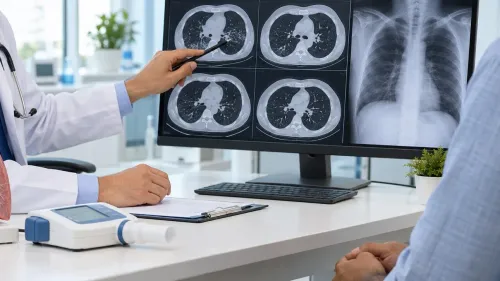
A high-resolution CT is justified when infections recur, affect one area, sputum production persists, or the course remains unexplained. It can show bronchiectasis through widened airways, loss of normal tapering and airways visible close to the pleura.
Spirometry assesses asthma or COPD, but a normal result does not exclude asthma; bronchodilator testing, peak-flow monitoring or bronchial provocation may be needed.
Why breathlessness needs more than a lung diagnosis
Breathlessness is a symptom, not a lung diagnosis. A specialist compares its timing, triggers, smoking or occupational exposure, examination findings, pulse, ECG, blood count and oxygen saturation at rest and during walking. Normal oxygen saturation at rest does not exclude exertional asthma, pulmonary embolism, interstitial lung disease or pulmonary hypertension.
| Possible source | Clues | Tests that separate it |
|---|---|---|
| Asthma or COPD | Variable wheeze, cough, smoking history, limited airflow | Spirometry with bronchodilator testing; COPD requires post-bronchodilator FEV1/FVC below 0.70. Normal spirometry does not exclude asthma. |
| Pulmonary embolism | Pulmonary embolism symptoms include sudden breathlessness, pleuritic chest pain, fast pulse or coughing blood | Urgent risk assessment, D-dimer when appropriate, and CT pulmonary angiography |
| Interstitial lung disease | Gradually worsening exertional breathlessness and persistent dry cough | High-resolution CT and full pulmonary-function testing |
| Pulmonary hypertension | Disproportionate exertional breathlessness, faintness or ankle swelling | ECG, echocardiogram and specialist assessment |
| Heart disease | Breathlessness lying flat, waking at night, leg swelling or chest pressure | ECG, echocardiogram and targeted cardiac tests |
| Anaemia | Fatigue, pallor and breathlessness with otherwise clear lungs | Complete blood count and iron studies |
| Deconditioning, obesity or dysfunctional breathing | Reduced fitness, rapid shallow breathing, tingling or symptoms tied to stress | History, exertional assessment and exclusion of disease |
A chest X-ray can miss early interstitial disease, small-airway disease and pulmonary embolism. Persistent unexplained symptoms need targeted testing rather than reassurance from a normal film.
What to expect from the specialist work-up and appointment
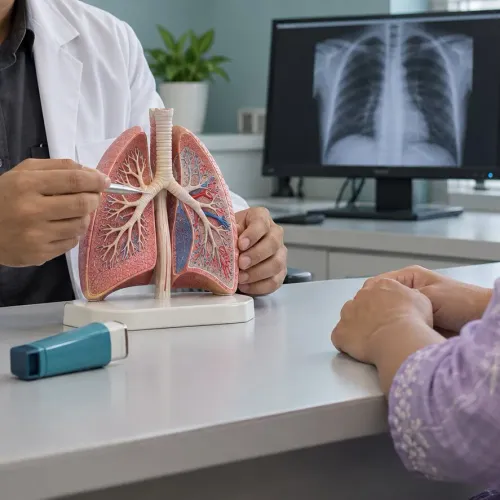
A lung specialist appointment usually starts with your symptom timeline, medication review, smoking or occupational exposure history, oxygen measurement and chest examination. A chest X-ray is useful for pneumonia, large masses and fluid, but chest X-ray limitations include missing early lung cancer, pulmonary embolism, small-airway disease and some interstitial lung disease.
1. Initial tests may include a chest X-ray and spirometry. COPD requires post-bronchodilator spirometry with a persistent FEV1/FVC ratio below 0.70; symptoms or an X-ray alone cannot establish it. A normal spirometry result does not exclude asthma, so the specialist may request bronchodilator testing, peak-flow records, bronchial provocation or airway-inflammation testing.
2. Persistent symptoms, repeated infections or daily sputum can lead to high-resolution CT for bronchiectasis. CT can reveal widened airways, obstruction or structural disease that an X-ray misses, but it does not identify every cause of cough and may need sputum cultures, immune tests or tuberculosis testing.
3. Bronchoscopy risks and benefits are weighed when imaging suggests an obstruction, bleeding source or unusual infection, or when tissue or airway samples are needed. Risks include bleeding, infection, bronchospasm, low oxygen and sedation complications; it is not a routine first test for every cough.
4. Bring prior X-rays and CT scans, reports, spirometry, discharge papers, sputum results, medication and antibiotic lists, inhalers, allergy details and vaccination records. Galaxy Chest & Multi Specialty Hospital Pvt Ltd can help coordinate airway investigations when examination and imaging point beyond routine treatment.
Related services
Theraputic to remove the polypoid like growth within the airway View service → |
Theraputic to prevent recurrent collection of fluid or air in the Pleural cavity View service → |
Frequently asked questions
When does a cough need specialist review?
An adult cough lasting more than eight weeks needs planned medical assessment, even when you otherwise feel well.
When do recurring chest infections suggest another problem?
Investigation is important when infections return, produce daily sputum, or repeatedly affect the same lung area.
When does breathlessness require urgent care?
Seek emergency care for severe or rapidly worsening breathlessness, blue lips, confusion, or chest pain. New, worsening, or activity-limiting breathlessness needs prompt medical review.
What happens during a lung specialist work-up?
The specialist reviews your cough, sputum, infection pattern, exposures, medicines, and activity limits, then selects tests such as chest imaging or lung function testing.