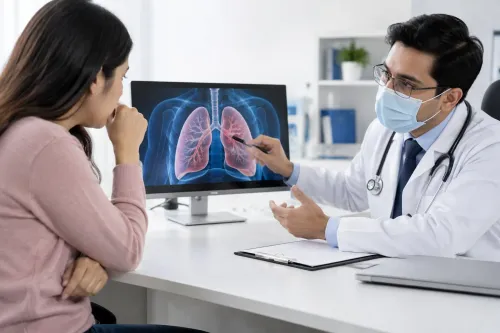
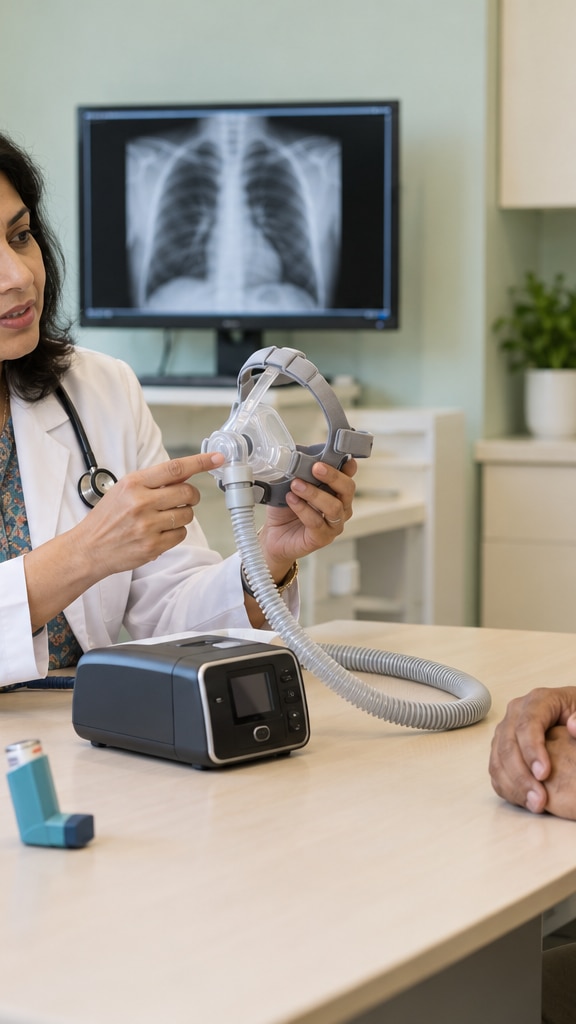
Wheezing, breathlessness, repeated chest infections and poor sleep can arise from different conditions that need different tests and treatments. You will learn when a pulmonologist is the right specialist, what to expect at the first visit, which warning signs need urgent care and how asthma, COPD, sleep apnea and respiratory infections are distinguished.
Key takeaways
- See a pulmonologist when symptoms recur, worsen, resist treatment or remain unexplained.
- Spirometry, symptom history and exposure patterns help distinguish asthma from COPD.
- Sleep apnea assessment focuses on sleep symptoms, breathing pauses and sleep-study findings.
- Ask for a clear treatment plan, warning signs and a follow-up date after diagnosis.
When should you see a pulmonologist instead of a general physician?
A general physician can assess many first episodes of cough, wheeze or breathlessness. When to see a pulmonologist becomes clear when symptoms recur, worsen, resist treatment or leave the diagnosis uncertain.
Arrange a routine specialist appointment for:
- Recurrent wheezing, night cough or breathlessness during activity
- Frequent use of a reliever inhaler
- Repeated chest infections or a cough that persists
- Loud snoring with witnessed breathing pauses, morning headaches or daytime sleepiness
- Abnormal oxygen levels
- Significant exposure to cigarette smoke, biomass fuel, dust, fumes or workplace chemicals
A pulmonologist for asthma, COPD, sleep apnea or repeated infections can confirm the cause and adjust treatment when initial care is not controlling symptoms. Seek a shortness of breath specialist when exertional symptoms keep returning rather than waiting for another flare-up.
Treat these emergency breathing symptoms as an immediate-care problem, not a routine appointment:
- Severe breathlessness or inability to speak full sentences
- Blue lips, confusion or marked drowsiness
- A low or falling oxygen reading
- Chest pain with respiratory distress
- A reliever inhaler that fails to work
Interpret a pulse oximeter alongside your symptoms. Motion, poor circulation, nail products, skin pigmentation and device limitations can distort readings; an unexpectedly low or worsening result needs urgent clinical assessment.
How are asthma and COPD told apart?
Symptoms alone do not establish asthma versus COPD. Asthma tends to fluctuate, while COPD causes persistent airflow limitation; both require objective testing.
| Feature | Asthma | COPD |
|---|---|---|
| Symptom pattern | Wheeze, night or early-morning cough, trigger-related attacks and periods of near-normal breathing | Persistent symptoms with progressively worsening breathlessness during exertion |
| Common context | Allergens, exercise, cold air, infections or irritants may trigger episodes | Cigarette smoke, biomass fuel exposure and occupational dust or fumes are common links |
| Age at onset | Often begins earlier, but adult-onset asthma occurs | More common later in life, but age does not establish the diagnosis |
| Testing pattern | Variable airflow limitation, including improvement after a bronchodilator | Persistent obstruction after a bronchodilator |
Asthma is supported when expiratory airflow varies. In adults, an FEV1 or FVC increase of at least 12% and 200 mL after a bronchodilator is commonly used as evidence of bronchodilator reversibility.
A normal test between episodes does not exclude asthma, so a clinician may repeat spirometry during symptoms, assess peak-flow variability or consider bronchial challenge testing.
COPD requires post-bronchodilator spirometry with an FEV1/FVC ratio below 0.70 under the GOLD strategy. Breathlessness or a smoking history alone is not proof. Clinicians interpret the FEV1 FVC ratio and other results against predicted values for your age, height and sex, then consider your clinical history and other causes of breathlessness.
What happens during the first pulmonology consultation?
Your first pulmonologist appointment is a structured assessment, not an automatic request for every available test. The clinician connects your symptom pattern, exposures, examination findings and previous records before choosing investigations.
1. Expect questions about when symptoms began, how often they occur, triggers, sleep disturbance, smoking, biomass-fuel exposure, workplace risks, allergies, previous infections, hospital visits and family history. Bring every inhaler, tablet and over-the-counter medicine. The clinician will check adherence, perform an inhaler technique review, and measure oxygen saturation, respiratory rate and chest sounds.
2. For spirometry preparation, bring all current inhalers, ask the clinic whether to withhold a bronchodilator and for how long, and avoid smoking before testing. Obstruction, reversibility and restriction describe breathing patterns, not final diagnoses; suspected restriction often needs full lung-volume testing.
3.
Additional tests answer specific questions: a chest X-ray for breathing problems such as suspected pneumonia or another structural issue; high-resolution CT lung imaging for interstitial disease or bronchiectasis; blood eosinophils and total IgE for selected airway-inflammation questions; allergy testing for a relevant trigger; sputum testing for suspected infection or unusual inflammation; and exercise oxygen assessment for exertional desaturation.
4. Bronchoscopy is reserved for selected problems, including unexplained bleeding, airway obstruction, or the need for washings or biopsy. It is not routine asthma review.
How are sleep apnea and respiratory infections assessed?
Snoring alone cannot establish an obstructive sleep apnea diagnosis. A pulmonologist asks about witnessed breathing pauses, choking during sleep, morning headaches and daytime sleepiness, and checks weight, alcohol near bedtime, sedatives and nasal obstruction.
The assessment may include a comprehensive sleep evaluation, polysomnography or an appropriate home sleep-apnea test. If a home test is negative but suspicion remains high, arrange follow-up polysomnography.
CPAP or APAP suits many adults, but the machine works only when treatment is usable. Check CPAP mask fit, leak control, humidification, pressure settings and regular use during follow-up. If you are sleepy while driving or operating machinery, stop those activities until the sleepiness is evaluated and controlled.
A respiratory infection assessment must separate overlapping conditions: pneumonia, viral bronchitis and asthma or COPD exacerbations can all cause cough, fever, sputum and breathlessness. Sputum colour alone does not prove bacterial infection. The clinician checks:
- Examination findings
- Oxygen saturation
- Respiratory rate
- Chest imaging when indicated
An acute COPD exacerbation does not automatically require antibiotics. Increased breathlessness, sputum volume and sputum purulence together, or a need for mechanical ventilation, provide stronger grounds.
Coughing up blood needs medical assessment. Seek emergency care for large-volume bleeding, breathlessness, chest pain, faintness or rapid deterioration.
What should treatment and follow-up include after diagnosis?
After diagnosis, useful treatment turns test results into a plan that prevents the next flare-up rather than simply adding medicine. Asthma inhaled corticosteroids treat airway inflammation; relying only on a short-acting reliever leaves that problem untreated.
1. For asthma, review inhaler technique, adherence, triggers and symptom frequency before increasing medication. Give you a written action plan stating which symptoms require extra treatment, a review and urgent care.
2. For COPD, use symptom burden and exacerbation history alongside lung function. Management may include stopping cigarette or biomass-smoke exposure, vaccination, physical activity, inhaler optimisation and COPD pulmonary rehabilitation. Pulmonary rehabilitation is supervised, individually prescribed exercise combined with education and behaviour change, not generic advice to walk more.
3. After an exacerbation, arrange clear follow-up to reassess symptoms, oxygen readings, medicines and inhaler technique. A written worsening-symptom plan should state whom to contact and where urgent deterioration is managed. Abnormal or falling oxygen readings need assessment with symptoms because motion, poor circulation, nail products and device limits can distort pulse oximeters.
4. For sleep-apnoea treatment, check mask fit, leaks, humidification, pressure settings and regular CPAP or APAP use. For respiratory infections, review recovery and investigate persistent fever, breathlessness or low oxygen rather than judging antibiotics by sputum colour.
For respiratory follow-up in Trichy, Galaxy Chest & Multi Specialty Hospital Pvt Ltd is a practical option when specialist pulmonology care needs consultation, testing, treatment and escalation decisions in one pathway; ask who reviews results and when inhaler technique is reassessed.
Related items
 | We are the best treating in Sleep Study in Trichy. It will be useful to find out the cause for sleep disorder like obstructive sleep apnoea. View product → |
Investigation Pulmonary Function Test(spirometry) to know the function of lung View service → |
Frequently asked questions
When should you see a pulmonologist instead of a general physician?
See a pulmonologist when cough, wheeze or breathlessness recurs, worsens, resists treatment or leaves the diagnosis uncertain.
How are asthma and COPD told apart?
Doctors compare symptom patterns, smoking or exposure history, examination findings and lung-function results, especially spirometry.
What happens during the first pulmonology consultation?
The consultation reviews your symptoms, medical and exposure history, medicines, previous reports and examination findings before deciding which tests you need.
How are sleep apnea and respiratory infections assessed?
Sleep apnea assessment uses sleep symptoms, witnessed breathing pauses and sleep testing; respiratory infections are assessed using symptoms, examination and targeted tests when needed.
What should treatment and follow-up include after diagnosis?
Your plan should name the diagnosis, medicines or other treatments, inhaler instructions, warning signs and a specific follow-up schedule.
Related service
Treatment we were the one exclusively meant for the heading View service → |