
Choosing a pulmonologist requires more than accepting a “best” claim: you need the right specialist, objective testing, a clear diagnosis and a follow-up plan that fits your condition. By the end, you will know which qualifications and consultation details to compare for asthma, COPD, chronic cough and other long-term respiratory problems.
Key takeaways
- Choose a pulmonologist with respiratory training and experience treating your specific diagnosis.
- Confirm asthma or COPD with spirometry instead of symptoms alone.
- Ask for inhaler technique review, exposure assessment and alternative-diagnosis checks.
- Compare testing access, follow-up plans and explanations before booking long-term care.
What qualifications should you compare when choosing a pulmonologist?
The right pulmonologist matches your condition, not just your symptom. Compare specialist training in pulmonology or respiratory medicine, experience with your diagnosis, access to spirometry and imaging, and skill in reviewing inhaler technique, adherence, smoking or allergen exposure, and alternative diagnoses before escalating treatment.
| Specialist | Qualifications and experience to compare | Best fit |
|---|---|---|
| Pulmonologist | Postgraduate training in respiratory medicine, regular spirometry interpretation, and experience managing long-term airway disease | Asthma, COPD, unexplained breathlessness, recurrent chest infections |
| Asthma specialist | Experience with difficult or severe asthma, allergy assessment, blood eosinophils, exhaled nitric oxide, biologic eligibility, and inhaled corticosteroid-based treatment | Frequent attacks, persistent symptoms, or poor control despite correct inhaler use |
| COPD specialist in Trichy | Experience confirming COPD with post-bronchodilator spirometry, including an FEV1/FVC below 0.70, plus pulmonary rehabilitation and oxygen assessment | Persistent airflow limitation, smoking-related breathlessness, chronic cough, or frequent exacerbations |
| Thoracic surgeon or critical-care physician | Surgical expertise for lung or chest disease, or intensive-care training for respiratory failure | A suspected tumour, severe airway or chest problem, ventilation, or an emergency rather than routine medication review |
Do not choose a doctor solely because they prescribe many inhalers. Ask whether they confirm the diagnosis objectively, distinguish asthma from COPD overlap, and check technique before adding medicines. A general physician may handle stable symptoms, while an allergist or sleep specialist is the better partner when allergy or sleep apnoea drives the problem.
The best pulmonologist is the one whose training and follow-up plan fit your actual treatment need.
How are asthma and COPD confirmed rather than guessed?
Asthma and COPD are confirmed with a symptom history, objective testing and spirometry results—not wheezing or breathlessness alone.
- Asthma symptoms vary: attacks after exercise, allergens, cold air or viral infections; night-time cough and improvement with a reliever inhaler support the pattern.
- COPD causes persistent breathlessness, cough or sputum that progresses over time, especially with tobacco smoke, biomass fuel or occupational dust exposure. A smoking history alone does not establish a COPD diagnosis.
- Other causes need separate evaluation, including heart disease, bronchiectasis, interstitial lung disease, vocal-cord dysfunction and recurrent infection.
Spirometry measures FEV1, the air forced out in one second, and FVC, the total air exhaled forcefully. In adults, an asthma diagnosis is supported when FEV1 rises by more than 12% and more than 200 mL after a bronchodilator.
A normal test on one day does not exclude asthma; repeat testing, peak-flow variability or challenge testing may be needed.
A COPD diagnosis requires a post-bronchodilator FEV1/FVC ratio below 0.70. Symptoms without this obstruction do not justify the label. Oxygen saturation, chest X-ray or CT, and targeted blood tests help identify complications or alternatives, but none replaces spirometry for COPD confirmation.
Blood eosinophils can guide inhaled-steroid decisions in COPD, not diagnose it. For difficult asthma, eosinophils, exhaled nitric oxide, allergy testing and exacerbation history help define phenotype after checking inhaler technique, adherence and ongoing exposures.
Which chronic respiratory condition could explain your symptoms?
The same breathlessness, wheeze or cough can reflect very different diseases. Chronic cough causes include asthma, reflux, upper-airway cough syndrome, smoking, occupational exposure and ACE-inhibitor medicines, so symptom duration alone cannot identify the condition.
| Condition | Clues that point towards it | Useful confirmation |
|---|---|---|
| Asthma | Variable wheeze, chest tightness or cough; symptoms triggered by allergens, exercise or cold air | Spirometry showing variable airflow, sometimes with bronchodilator response |
| COPD | Persistent exertional breathlessness, smoking or pollutant exposure, daily sputum | Post-bronchodilator FEV1/FVC below 0.70; symptoms alone do not confirm COPD |
| Bronchiectasis | Daily thick or foul-smelling sputum, repeated chest infections, coughing blood | High-resolution CT showing permanently widened airways |
| Interstitial lung disease | Progressive exertional breathlessness, dry cough and fine “Velcro” crackles | High-resolution CT and lung-function testing; a normal X-ray does not exclude early disease |
| Vocal-cord dysfunction | Sudden throat tightness, noisy breathing when breathing in, poor response to asthma inhalers | Laryngoscopy during symptoms |
| Recurrent infection | Fever, purulent sputum, repeated localized infiltrates or slow recovery | Chest imaging, sputum testing and review of immune or structural problems |
A normal chest X-ray does not rule out airway disease, pulmonary embolism, early interstitial lung disease or lung cancer. CT should answer a specific clinical question because it adds radiation and can reveal incidental findings; sudden “COPD flare-ups” also require checks for pneumonia, heart failure, pulmonary embolism, pneumothorax, arrhythmia and incorrect inhaler use.
What should a thorough asthma or COPD consultation include?
A thorough asthma consultation looks for why control is poor before adding another medicine. The pulmonologist should review symptoms, test results, daily treatment, technique, exposures and possible alternative diagnoses, then agree on measurable follow-up goals.
Ask whether the consultation includes:
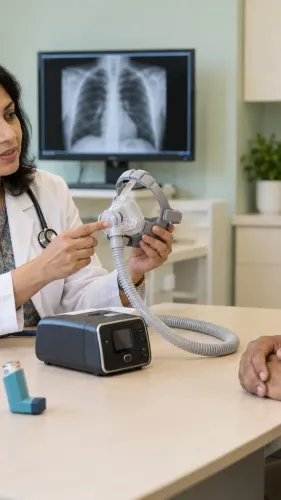
- A direct demonstration of inhaler technique, including device preparation, inhalation speed, breath-holding and spacer use. A good prescription fails if the medicine stays in your mouth instead of reaching the lungs.
- A check of missed doses, refill gaps, cost, side effects and whether the regimen fits your routine. Asthma treatment should include an inhaled corticosteroid-containing regimen; a short-acting bronchodilator alone does not control airway inflammation.
- Questions about cigarette smoke, biomass fuel, workplace dust, mould, pets, reflux, nasal disease and medicines such as beta-blockers or aspirin.
- Review of spirometry, bronchodilator response, blood eosinophils or allergy findings when relevant, rather than diagnosing asthma from wheezing alone.
- A written asthma action plan or COPD treatment plan that states daily medicines, worsening symptoms, rescue steps, review timing and emergency thresholds.
| Check during review | Problem it may uncover | Why it changes treatment |
|---|---|---|
| Sudden COPD worsening | Heart failure, pneumonia, pulmonary embolism, pneumothorax or arrhythmia | Antibiotics or steroids alone may be unsafe or ineffective |
| Persistent airflow limitation with asthma features | Asthma-COPD overlap | Avoiding inhaled corticosteroids can be hazardous |
| Breathlessness with low oxygen readings | Severe gas-exchange impairment | Long-term oxygen requires documented criteria, not breathlessness alone |
| Repeated flare-ups | Poor technique, exposure or an untreated diagnosis | Fixing the cause can prevent unnecessary escalation |
How can you compare pulmonologists before booking follow-up care?
A reliable follow-up team gives you a clear route between appointments, reviews evidence rather than symptoms alone, and explains what to do when control worsens. Use this pulmonologist comparison before booking:
| Standard | Reliable sign | Warning sign |
|---|---|---|
| Follow-up access | A named clinician, defined review interval and phone process for worsening symptoms | No answer after starting or changing treatment |
| Report review | The team examines spirometry, oxygen readings, imaging and blood results with you | Results are filed without explaining the next decision |
| Inhaler education | A nurse or doctor watches your technique, checks adherence and provides a written action plan | More medicines are added without checking technique |
| Emergency support | Clear instructions for severe breathlessness, blue or grey lips, confusion, chest pain or falling oxygen levels | You are told to wait for a routine appointment |
| Referrals | Direct links to pulmonary rehabilitation, sleep assessment, thoracic surgery or cardiology when indicated | Every problem is treated as an asthma or COPD flare |
Ask whether long-term oxygen assessment uses resting measurements in stable disease, not breathlessness alone. In COPD, oxygen saturation of 88% or less or arterial oxygen tension of 55 mmHg or less supports continuous oxygen consideration; pulmonary hypertension, edema or secondary polycythemia can alter the decision.
For respiratory care in Trichy, Galaxy Chest & Multi Specialty Hospital Pvt Ltd is one option to assess by asking who reviews reports, teaches inhalers and coordinates referrals. Seek emergency care immediately for severe symptoms rather than waiting for follow-up.
Related items
Theraputic to remove the polypoid like growth within the airway View service → |
 | We are the best in treating Rigid Bronchoscopy in Trichy. Mainly useful in removal of foreign bodies from the lumen of airway. View product → |
Frequently asked questions
What qualifications should you compare when choosing a pulmonologist?
Compare specialist training in pulmonology or respiratory medicine, experience with your condition, access to spirometry and imaging, and ability to assess inhaler use, exposures and alternative diagnoses.
How are asthma and COPD confirmed rather than guessed?
Doctors use your history, examination and lung-function testing, especially spirometry. Results are interpreted alongside smoking or exposure history, symptom patterns and other possible causes.
Which chronic respiratory condition could explain your symptoms?
Asthma, COPD, bronchiectasis, chronic infection, sleep-related breathing disorders and other lung or airway conditions can cause persistent cough, wheezing or breathlessness. A pulmonologist compares symptom timing, exposures, examination findings and test results.
What should a thorough asthma or COPD consultation include?
It should cover symptom history, smoking and allergen exposure, current medicines, inhaler technique, adherence, lung-function testing, relevant imaging and a clear treatment and follow-up plan.
How can you compare pulmonologists before booking follow-up care?
Ask which tests are available, who reviews the results, how inhaler technique is checked, when follow-up occurs and what symptoms require earlier review.