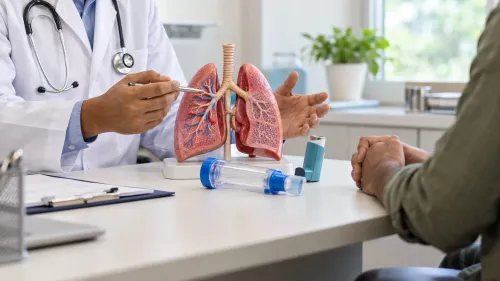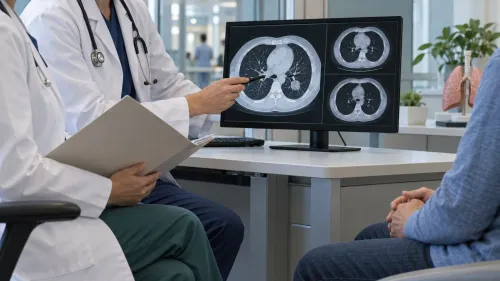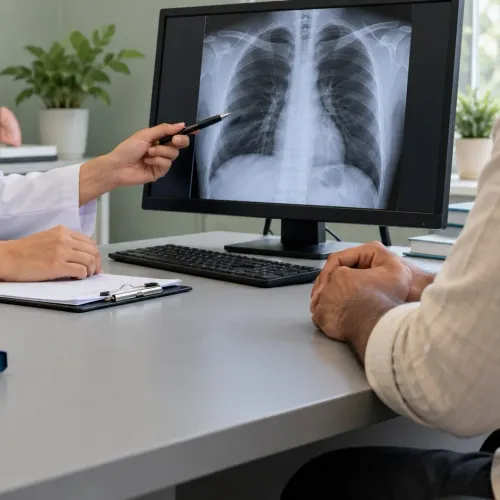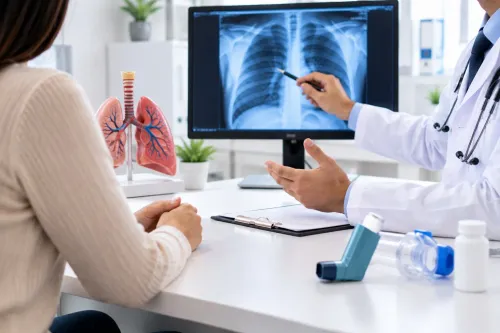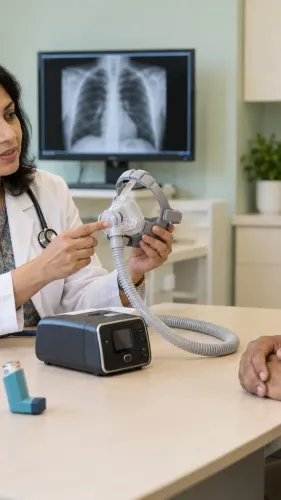
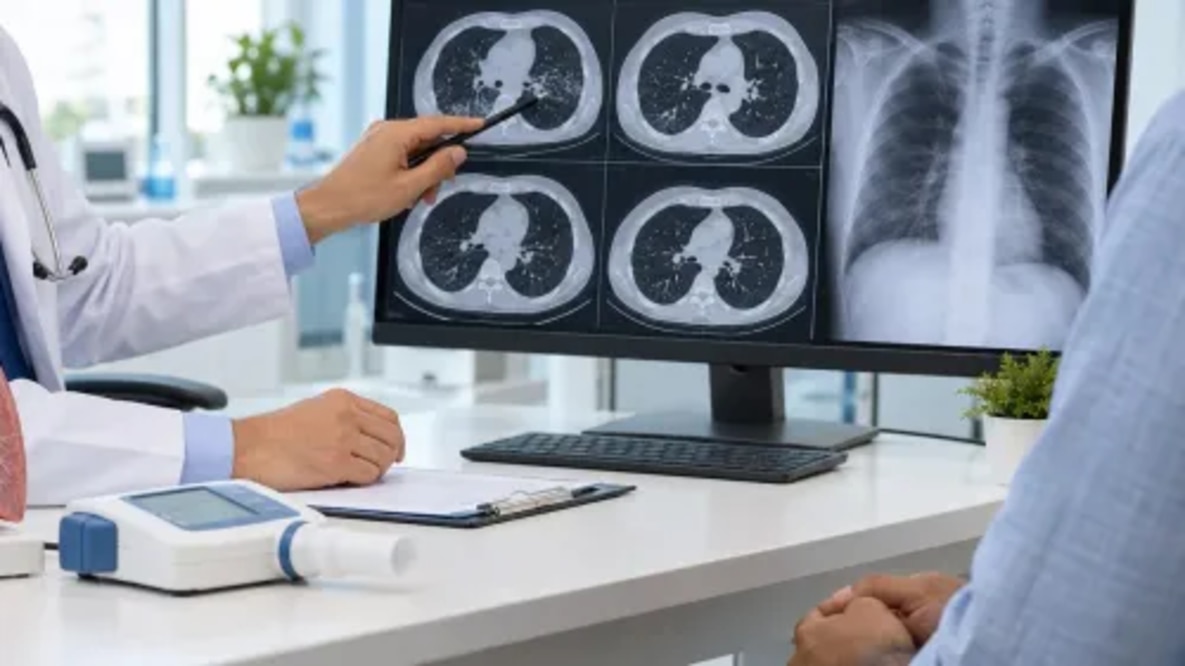
Breathing symptoms range from treatable asthma and infection to conditions that need urgent hospital care, and breathlessness alone does not identify the cause. Use the guidance below to decide which specialist you need, recognise emergency warning signs, compare diagnostic services and prepare for a productive first visit.
Key takeaways
- Seek urgent care for sudden severe breathlessness, chest pain, or coughing blood.
- Compare lung specialists by expertise, diagnostic access, and coordination with other doctors.
- Bring symptom details, medication lists, prior reports, and imaging to your first visit.
- A sleep study records breathing, oxygen, heart rate, and sleep patterns overnight.
What does a pulmonologist treat, and when is breathing trouble urgent?
A pulmonologist treats asthma, chronic obstructive pulmonary disease, pneumonia, tuberculosis, interstitial lung disease, pulmonary fibrosis, pulmonary hypertension, sleep-related breathing disorders and lung cancer. Breathlessness is not automatically asthma or COPD: heart disease, anemia, pulmonary embolism, medication effects, deconditioning, dysfunctional breathing and upper-airway disorders can produce similar symptoms.
A cough lasting more than eight weeks needs a different evaluation from a short viral cough; chest radiography, spirometry and a medication review often help identify causes such as an ACE-inhibitor cough, reflux or upper-airway cough syndrome.
| Specialist | Best fit | When it applies |
|---|---|---|
| Pulmonologist | Lung and breathing disorders | Persistent cough, wheeze, abnormal imaging, low oxygen or suspected lung disease |
| General physician or cardiologist | Whole-body or heart-related symptoms | Breathlessness with swelling, palpitations, anemia or exertional chest pressure |
| Allergist or ENT specialist | Allergy or upper-airway causes | Nasal symptoms, throat clearing, hoarseness or suspected vocal-cord dysfunction |
| Sleep physician, oncologist or thoracic surgeon | Sleep, cancer or surgical care | Sleep-apnoea symptoms, confirmed cancer or a tumour requiring staging or removal |
Do not schedule a routine PulmonologistNearMe appointment if you have:
- Severe breathlessness at rest, blue or gray lips, new confusion, fainting or a new oxygen reading of 90% or lower.
- Chest pain with shortness of breath.
- More than a small amount of blood when coughing.
Call emergency services. A BestPulmonologist cannot safely replace immediate triage.
How to choose the best pulmonologist near you
Choose a pulmonologist by evidence of training, relevant experience and reliable follow-up—not by proximity alone. A PulmonologistNearMe search creates a shortlist; it does not prove who is best for your condition.
Check these points before booking:
- Confirm board certification or a recognized specialist qualification, plus fellowship training in pulmonary and critical care medicine.
- Ask how often the doctor manages your problem, such as asthma, COPD, tuberculosis, pulmonary fibrosis, pulmonary hypertension, sleep-related breathing disorders or lung cancer.
- Verify access to accredited pulmonary-function testing, including spirometry, lung volumes and diffusing capacity (DLCO). In India, ask whether the laboratory holds NABL accreditation.
- Check hospital privileges, 24-hour emergency support and access to oxygen, intensive care and urgent imaging.
- Ask whether the practice coordinates referrals to oncology, thoracic surgery, sleep medicine and pulmonary rehabilitation. Rehabilitation should include individualized exercise, education and behaviour change—not only breathing advice.
- Judge communication during the first call: does the clinician explain uncertainty, medication risks, test purposes and warning signs in language you understand?
Compare what each shortlist candidate can provide:
| Priority | What to verify | Why it matters |
|---|---|---|
| Condition expertise | Recent experience with your diagnosis | Similar symptoms can have different causes and treatments |
| Testing | Accredited spirometry, lung volumes and DLCO | One low FEV1/FVC ratio cannot identify every disease |
| Hospital access | Emergency department, ICU and inpatient coverage | Deterioration needs treatment beyond a clinic visit |
| Coordination | Named oncology, surgery, sleep and rehabilitation links | Complex care rarely ends with one consultation |
| Communication | Clear answers and a documented plan | Poor understanding leads to missed doses and delayed escalation |
What to bring and what happens at the first lung-care appointment
Bring a LungCare folder with prior reports, chest X-rays or CT images, discharge summaries, vaccination records, allergy history and a written symptom timeline. Pack every medicine, inhaler and supplement, including dose and frequency; do not stop inhalers unless instructed.
Galaxy Chest & Multi Specialty Hospital Pvt Ltd can help maintain continuity when you carry earlier scans and medication lists rather than repeating tests unnecessarily.
The clinician will ask when symptoms began, what triggers them, smoking or occupational exposures, infections, sleep symptoms, exercise tolerance and family history. Examination includes breathing pattern, chest sounds, heart rate, blood pressure, weight and oxygen saturation by pulse oximeter.
Ask how oxygen readings change with walking and whether medicines, smoke, dust or workplace chemicals affect them.
- Spirometry measures airflow; poor effort, coughing, early stopping or an air leak can make the report unreliable. Acceptable, repeatable blows matter more than one impressive number.
- Bronchodilator testing repeats spirometry after an inhaled medicine to assess reversible narrowing.
- Ask whether symptoms require more than one test, especially before surgery.
| Test | Main question | When it helps |
|---|---|---|
| Spirometry | Is airflow reduced? | Asthma or COPD assessment |
| Bronchodilator test | Does airflow improve? | Suspected reversible obstruction |
| Peak-flow monitoring | How variable is airflow? | Home asthma tracking |
| Diffusion capacity | How well does gas cross lung tissue? | Emphysema or interstitial disease |
| Chest X-ray | Is there a broad structural problem? | Infection or persistent symptoms |
| High-resolution CT | What does fine lung detail show? | Fibrosis or small abnormalities |
| Allergy testing | What sensitises you? | Trigger-linked symptoms |
| Arterial blood gas | What are oxygen, carbon dioxide and acidity? | Severe or complex respiratory illness |
When a sleep study helps—and what the test actually measures
Loud snoring, witnessed pauses in breathing, gasping during sleep, morning headaches, dry mouth and excessive daytime sleepiness point toward a sleep-related breathing disorder. A sleep study records what happens during sleep; a consultation reviews your history, while overnight oximetry records oxygen saturation and pulse only.
Oximetry can suggest a problem but cannot show whether airway blockage caused it.
| Test | What it measures | When it applies |
|---|---|---|
| Laboratory polysomnography | Brain activity, sleep stages, breathing, heart rhythm, oxygen and limb movements | Unclear or complex cases, insomnia, neuromuscular disease, or suspected central apnoea |
| Home sleep-apnoea test | Airflow, breathing effort, pulse and oxygen during sleep at home | Adults with a straightforward suspicion of obstructive sleep apnoea |
During polysomnography, sensors measure:
- Brain waves, eye movements and chin muscle activity to identify sleep stages
- Nasal airflow, chest and abdominal effort to detect pauses and obstruction
- Oxygen saturation, heart rhythm and leg movements to identify related strain or periodic limb movements
Follow the laboratory’s instructions, avoid alcohol, keep your usual sleep schedule and bring your medication list. Results guide options such as weight management, CPAP, mandibular advancement devices or further airway assessment.
If insomnia dominates, or restless legs symptoms suggest iron deficiency or another neurological cause, assess that problem first rather than treating every poor night as apnoea. A PulmonologistNearMe search should lead to coordinated LungCare, not a test chosen without clinical review.
How testing and specialist coordination shape long-term treatment
Breathlessness alone does not justify home oxygen. A BestPulmonologist bases long-term oxygen treatment on documented hypoxaemia: severe resting hypoxaemia is PaO2 of 55 mm Hg or lower, or oxygen saturation of 88% or lower, with qualifying complications such as pulmonary hypertension, oedema or erythrocytosis. Confirm the reading and its cause before using oxygen.
Pulmonary rehabilitation is active treatment, not simply a breathing class. It combines individualised exercise training, education, inhaler technique, nutrition and behaviour change to improve exercise capacity, symptoms and daily function. This coordinated LungCare approach is useful for appropriate people with COPD, interstitial lung disease and other chronic respiratory conditions.
| Investigation | What it answers | When it applies |
|---|---|---|
| Low-dose CT screening | Does a high-risk person have an early lung abnormality? | Usually adults aged 50–80 with at least 20 pack-years who currently smoke or quit within 15 years; local guidance can differ |
| Diagnostic chest CT | What explains symptoms or an abnormal X-ray? | Chronic cough, weight loss, coughing blood or a suspicious finding |
| Nodule follow-up CT or PET/CT | Has a nodule grown or become more active? | Based on size, density, shape, growth, smoking history and prior cancer |
Chronic cough assessment reviews medicines, asthma, reflux, upper-airway disease, spirometry and imaging. Suspicious nodules may need bronchoscopy or needle sampling; confirmed cancer then requires PET/CT, selected brain imaging, mediastinal staging and biomarker testing before multidisciplinary treatment. Before thoracic surgery, clinicians assess predicted postoperative FEV1 and DLCO, exercise capacity and, when needed, cardiopulmonary exercise testing.
Frequently asked questions
What does a pulmonologist treat?
A pulmonologist treats asthma, COPD, pneumonia, tuberculosis, interstitial lung disease, pulmonary fibrosis, pulmonary hypertension, sleep-related breathing disorders, and lung cancer.
When is breathing trouble urgent?
Seek urgent medical care for sudden or severe breathlessness, chest pain, blue lips, confusion, fainting, or coughing blood.
How do I choose the best pulmonologist near me?
Compare the doctor’s experience with your condition, available lung testing, access to interventional pulmonology or thoracic surgery, and coordination with other specialists.
What should I bring to my first pulmonology appointment?
Bring your symptom timeline, medication and allergy list, previous reports, chest X-rays or CT scans, test results, and questions about your breathing problems.
What does a sleep study measure?
A sleep study measures breathing interruptions, oxygen levels, heart rate, airflow, body movement, and sleep-related patterns during the night.
Keywords